Beware the Wormtongue

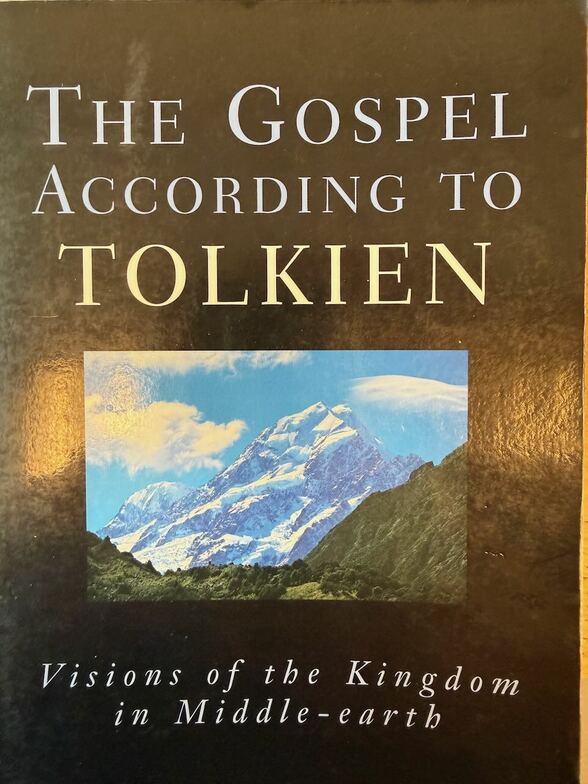
Lately, as part of my own spiritual reading, I have returned to a rather unexpected set of books: The Hobbit and J.R.R. Tolkien’s The Lord of the Rings. I have even suggested to the Finding God in the Movies group that they might enjoy watching the movies as they are strongly linked to Christian spirituality.
I say “spiritual reading” quite deliberately.
Tolkien was a devout Roman Catholic, and although The Lord of the Rings is not an allegory of Christianity—Frodo is not simply Jesus, Gandalf is not simply a prophet, and Sauron is not simply Satan—the Christian imagination is woven deeply into the fabric of Middle-earth.
The more slowly I read it, the more I notice it. The more times I read it, the deeper it becomes.
There is Frodo, the small and unlikely bearer of an enormous burden, discovering that courage is not the absence of fear but the willingness to continue carrying what has been entrusted to him.
There is Samwise Gamgee, whose extraordinary faithfulness may be one of the most beautiful portraits of friendship in modern literature. When hope disappears, Sam stays. When Frodo can hardly continue, Sam stays. He cannot carry Frodo’s burden for him, but he can help carry Frodo.
There is Gandalf, the wise guide who confronts darkness without becoming dark himself, and who understands that mercy matters even when mercy seems foolish.
There is Aragorn, first known simply as Strider, the hidden king who does not grasp after his crown but grows into it through service, sacrifice and faithfulness. And there is the unlikely friendship of Legolas and Gimli, in which ancient divisions slowly give way to affection.
Again and again Tolkien returns to themes that belong deeply within the Christian imagination: power and temptation, mercy and sacrifice, friendship and fidelity, providence and hope.
Perhaps most strikingly, the fate of Middle-earth repeatedly turns upon people whom the powerful would consider insignificant. Hobbits are not warriors or kings. They are small people who would generally prefer supper and a warm fire to adventure. Yet Tolkien places the future of the world into their hands.
There is something wonderfully Gospel-like about that. God has always had a rather inconvenient habit of entrusting important things to unlikely people. But recently I came again to a part of Tolkien’s story that struck me differently. It is the story of Rohan.
The King Who Had Forgotten His Strength
When Gandalf, Aragorn, Legolas and Gimli arrive at Edoras, something is terribly wrong. Rohan is still a kingdom. Théoden is still its king. The Golden Hall is still standing. The Rohirrim remain a courageous people. And yet something has happened to the heart of the kingdom.
Théoden, their king, has become diminished. He sits hunched and aged upon his throne, suspicious of those who might help him and increasingly disconnected from the people who love him. His courageous nephew Éomer has been imprisoned. His niece Éowyn watches helplessly as the king she loves seems to disappear before her eyes.
And beside the king stands his counsellor: Gríma Wormtongue.
What a name Tolkien gives him.
Wormtongue does not conquer Rohan with an army.
He whispers.
He insinuates.
He interprets everything in the worst possible light.
He makes loyalty appear suspicious and courage appear dangerous. He turns Théoden against people who genuinely love him. He feeds fear, resentment and mistrust. Again and again his words make the king—and therefore the kingdom—smaller, weaker and more isolated.
And eventually we discover why.
Wormtongue is serving Saruman.
His words are not idle gossip. They have a purpose. Saruman wants Rohan weakened so that Rohan can eventually be conquered. And Wormtongue has discovered that one of the most effective ways to destroy a community is not always to attack it from outside. Sometimes you simply poison its relationships from within.
But there is something even more subtle happening. Wormtongue’s particular genius is not simply that he lies. He teaches Théoden how to interpret everything.
Loyalty becomes threatening. Courage becomes foolishness. Friendship becomes interference. Those who might challenge Wormtongue are portrayed as dangers to the king. Éomer, one of Rohan’s most loyal sons, ends up imprisoned while Wormtongue remains beside the throne.
Slowly Théoden begins to inhabit the world Wormtongue has described for him.
That, I think, is one of the reasons gossip and slander are so destructive.
Their greatest danger is not simply that something untrue may be said about another person.
It is that they invite us to begin seeing that person through the distortion.
A story is told. A motive is assigned. An action is interpreted. A suspicion is planted.
And soon we are no longer encountering the person themselves. We are encountering the story someone else has constructed about them.
Communities can become captive to those stories. Families can. Workplaces can. Churches can.
Middle-earth may be imaginary, but Tolkien understands something painfully real about human communities:
Words can build kingdoms. And words can destroy them.
“Only What Is Good for Building Up”
Reading the story of Rohan, I found myself thinking of St. Paul. Writing to the Christians at Ephesus, Paul tells them to be “speaking the truth in love.”
Why?
Because Paul imagines the Church as a living body, joined together in Christ, growing toward maturity and “building itself up in love.” Then, only a few verses later, Paul returns to exactly the same image: “Let no evil talk come out of your mouths but only what is good for building up…so that your words may give grace to those who hear.”
And shortly afterwards:
“Put away from you all bitterness and wrath and anger and wrangling and slander, together with all malice.”
Paul is not simply teaching Christians to be polite. He is describing how Christian community is constructed. Our words are part of the architecture of Christian community. Every conversation lays another stone. Some words strengthen the house. Others loosen the stones.
That is why Paul’s language of “building up” matters so much. The Greek word behind it, oikodomē, carries precisely that sense: construction, edification, building a house.
For Paul, Christians are not merely individuals trying to behave themselves. We are members of one Body. What I do affects you. What you do affects me. And therefore the way we speak to and about one another helps determine what kind of community we are becoming.
Just before speaking about our words, Paul even warns Christians not to “make room for the devil.”
The sequence is striking.
Do not give evil room to operate among you. Speak the truth in love. Speak what builds up. Put away bitterness, slander and malice.
Wormtongue does precisely the opposite.
He is an anti-builder. His words do not build up. They diminish. They do not give grace to those who hear. They poison. They do not strengthen relationships. They create suspicion. They do not seek reconciliation. They cultivate division.
Saruman wants the house of Rohan to fall. Wormtongue loosens its stones from within. And that gives us a remarkably useful Christian test for our own speech:
Does what I am about to say build up?
And that question has to begin with me. Before I use it to judge someone else’s words, I have to allow it to judge my own.
Truth-Telling and Gossip Are Not the Same Thing
That does not mean Christians should avoid difficult conversations. Christian speech is not always comfortable speech. Sometimes love requires us to name what is wrong. Sometimes we must defend someone who is being harmed. Sometimes faithfulness requires challenging destructive behaviour. Sometimes justice demands that we speak when it would be much easier to remain silent.
Silence itself can sometimes become a failure of love. But there is a profound difference between courageous truth-telling and gossip. Christian truth-telling seeks healing, justice, repentance, reconciliation and ultimately restoration. Gossip simply diminishes another person. Gossip speaks about someone for the sake of the story; love seeks the right person, the right place and the right purpose for speaking. Slander takes what is distorted or untrue and allows it to travel. Malicious speech passes along a story because, somewhere within us, we are willing for that story to diminish someone else.
And gossip can even disguise itself as concern:
“I probably shouldn’t say this, but…”
“I’m only telling you because I’m worried…”
“Have you heard…?”
By the time the story has travelled through five people, no one quite knows where it began.But everyone has been affected by it.
That is Wormtongue’s world.
And Paul tells Christians that it cannot be ours.
There Is No Neutral Gossip
Our words are always doing something.
They are strengthening trust or weakening it.
They are increasing courage or increasing fear.
They are helping people understand one another or encouraging them to suspect one another.
They are building up or tearing down.
There is no neutral gossip. Gossip never merely passes information along; it changes relationships. It alters how we see one another. It either strengthens the distortions already among us or introduces new ones.
Anyone who has lived in a family, worked in an organization, belonged to a parish or served in a community knows what happens when gossip becomes part of the culture.
Everyone becomes cautious.
People begin wondering what is being said when they leave the room. Trust contracts. Creativity disappears. Generosity becomes harder. People begin protecting themselves rather than offering themselves. The community becomes smaller.
That is precisely what has happened to Rohan.
Saruman does not merely want Théoden defeated.
He wants Théoden diminished. Because diminished people are easier to conquer.
And this is where Tolkien’s story becomes spiritually serious for me.
The Christian life is fundamentally about becoming more alive in Christ—not smaller, more suspicious, more bitter or more afraid.
Paul therefore offers another way: “Be kind to one another, tenderhearted, forgiving one another.” And then comes his great summary: “Walk in love.”
That is the opposite of Wormtongue.
It is also the vocation of the Church.
When Théoden Stands
And then comes one of my favourite moments in the story.
Gandalf confronts the darkness that has settled over Théoden.
And the king begins to awaken.
He stands.
He walks outside.
He feels the air again.
He looks upon his people.
Éomer is restored to him.
And Théoden takes up his sword.
Slowly we realize that the old man we encountered hunched upon the throne has not disappeared.
Théoden is still there.
The king remembers who he is.
And Rohan begins to remember who it is.
There is something deeply Christian about that.
Because the Gospel continually calls us to remember who we are.
We are not people formed by suspicion.
We are not people sustained by gossip.
We are not people who need to diminish another person in order to become larger ourselves.
We are the Body of Christ.
And therefore our speech should sound like the kingdom to which we belong.
We speak truthfully.
We speak directly.
We speak with love.
We speak toward reconciliation.
And we ask whether our words are building up the Body or slowly tearing it apart.
Perhaps that is why I have found myself reading Tolkien as spiritual reading. Middle-earth is imaginary. But the choices its characters face are not.
Every day we decide whether we will be Sam or Wormtongue: whether we will carry another person’s burden or add to it; whether our words will give courage or spread suspicion; whether we will participate in the healing of a community or in its diminishment.
St. Paul gives us a wonderfully simple measure:
Speak “only what is good for building up…so that your words may give grace to those who hear.”
That seems to me a pretty good rule for Middle-earth.
And an even better one for the Church.
Blessings,
Dean Chris