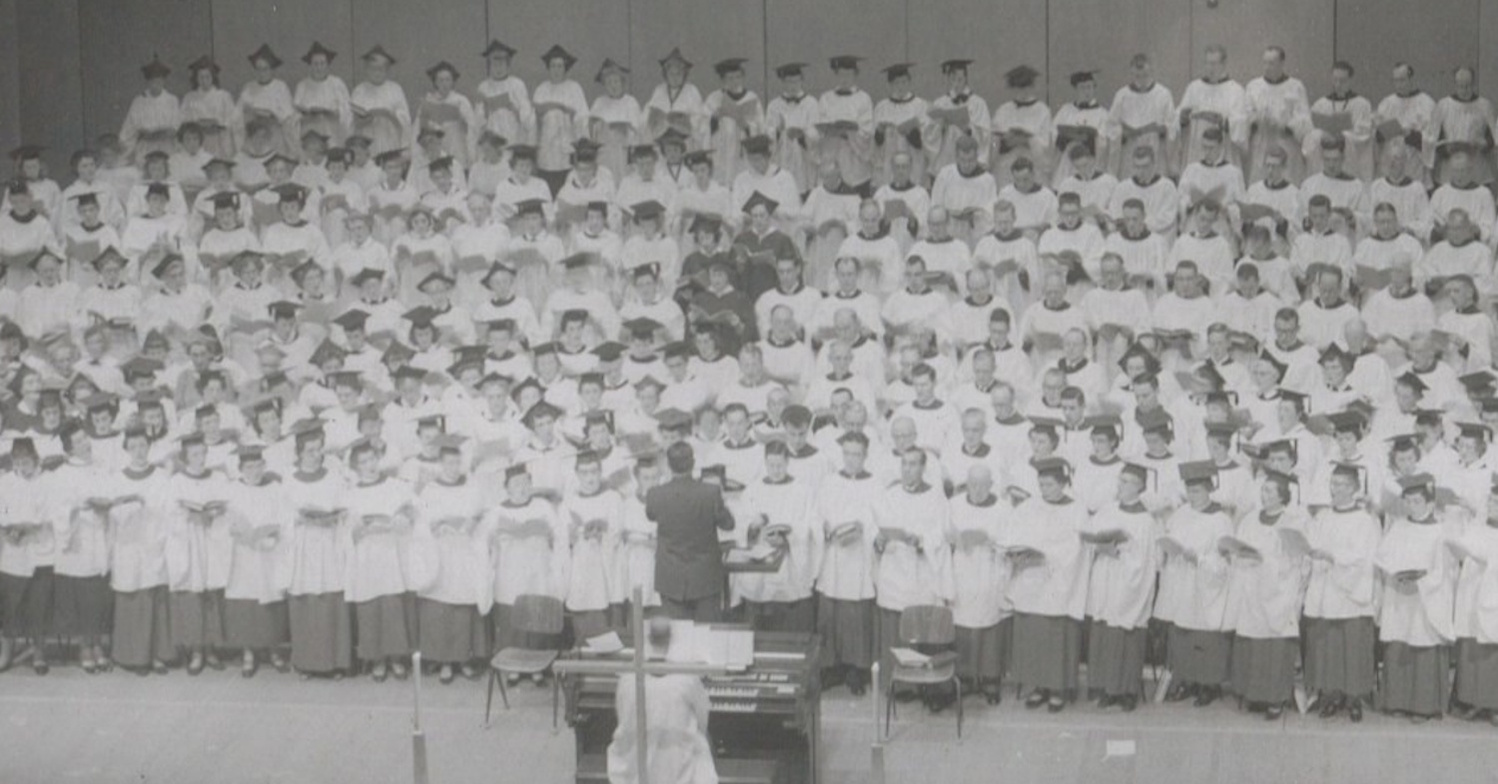
On May 29 a massed choir will assemble at the Cathedral as part of the Diocesan Mission Conference. Massed choirs have often been part of special events and celebrations in the past, such as the installation of bishops; one notable example was the 1959 Service of Thanksgiving on the centenary of the Anglican Church in British Columbia, held at the Queen Elizabeth Theatre (photo above by Basil Fox, © the Diocese of New Westminster Archives). Yet at one point Christ Church was the focus of an annual choir festival which ran for almost twenty-five years in the first half of the twentieth century – this is its story.
The Festival of Combined Anglican Choirs, to give the event its full title, originated at a meeting held at the house of Christ Church’s organist Frederick Chubb in the autumn of 1913. This preliminary gathering included representatives from St. Michael’s, St. Paul’s, St. Nicholas’ and St. Mark’s. A more formal gathering occurred on December 11, 1913, with W.H. Barton (St. Michael’s) as the first chairman and George Bullen (St. Mark’s) as secretary. The aim of the new association was “To raise the standard and stimulate a greater interest in church music, and to cultivate a more uniform rendering of the church music.”
The first Festival service was held at Christ Church on February 5, 1914 with Bullen as conductor and Chubb playing the organ; the massed choir from St. Mark’s, St. Michael’s, St. Luke’s, Christ Church, St. Paul’s, St. Saviour’s, and St. George’s totalled some two hundred and fifty choristers. The original intent had been to follow the example of the Three Choirs Festival in England (which rotates between the cathedrals of Hereford, Gloucester, and Worcester) and hold the festival in a different church each year, but after the success of the first service it was realized that Christ Church was the only structure capable of accommodating the large choir and congregation involved. Subsequently the festival remained at Christ Church, but a different conductor was chosen each year to lead the massed voices; the organist was almost always Chubb, perhaps because the Hope Jones organ was not the easiest instrument to navigate. To alleviate the problems of seating free tickets were made available which assured the holder a seat until 7:45pm, at which point all remaining seats became open and unreserved (the services began at 8pm). “A feature of this festival in its later years was an imposing temporary choir grand-stand which extended completely across the front of the chancel of Christ Church.” The festival ran annually from 1914 to 1938 with these exceptions: in 1921 two were held as the date changed from February to November; and as far as we can tell there were no festivals in 1935 or 1936.
Beginning with the Second Festival in 1915, special bound booklets were published annually by Novello & Co. of London containing the order of service and all the music, usually forty-eight pages excluding covers; these formed the basis for choir libraries for many years thereafter. We are fortunate to have access to at least five of these booklets in local archives. The service was normally an expanded evensong with an additional anthem and also including a Te Deum. For 1915 this was the repertoire: Festal Responses, hymns “To the Name of our salvation,” “Praise the Lord, ye heavens adore Him” (before the sermon), “The King of Love my shepherd is” (after the sermon), and “All Glory, Laud and Honour” (recessional), Psalm 68 to Anglican chant by Crotch and Cooke, Magnificat and Nunc Dimittis in B flat by Stanford, the multi-section anthem Praise the Lord, O my soul (John Goss), a Te Deum by John Stainer, and the Dresden Amen. In 1916 the anthem for the Third Festival was “The Heavens are Telling” by Joseph Haydn, also featured in the Sing Without Ceasing Festival on May 29. Overall much of the repertoire is unknown to us now, particularly those items stemming from Victorian times (e.g., the anthems God came from Teman by Charles Steggall or “Abide with me” from The Woman of Samaria by William Sterndale Bennett), but the services also included contemporaneous works such as a set of evening canticles by John Ireland; the very last festival in 1938 ended with the Festival Te Deum of Vaughan Williams, written for the coronation of George VI the previous year.
“The list of music sung at the festival … includes many compositions which would not have come within the ordinary work of smaller choirs, but which is not only a pleasure, but an education, to take part in: and there is no doubt that the standard of ecclesiastical music set at these festivals has really exercised some influence for good.” [Province, 26 October 1927]