The Gospel According to the Fugitives

On a sunny day in June of this year I landed in Whitehorse, Yukon Territory, for my second ever visit. My first visit last year was a flurry of activity as Cathedral dean Vincent Fenga (who has since transitioned from a Very Reverend into a Right Reverend!) found ways to connect me to the community so that he could jet off to General Synod. I made a lot of connections, but not with much depth.
Here was my chance to deepen my relationship with some of the new friends I’d made, and go on a terribly fun excursion.
I was driven to the Old Log Rectory and picked up there by Judy Greenhill, a parishioner of the Cathedral. Along with her husband Rick Avery, she is Canadian folk and children’s music royalty. For my Millennial compatriots: Rick and Judy introduced Sharon, Lois, and Bram to each other.
Judy swung me by the Superstore to pick up provisions for the empty kitchen at the rectory, and once I had availed myself of my favourite things I was bundled in to the apartment, which, by the grace of God, had no WiFi and could therefore provide a lovely container for the quiet few days I had before the weekend, when Rick and Judy would sweep me off to Haines Junction, about two hours west of Whitehorse, for the Kluane Mountain Bluegrass festival. Every year, Rick told me, he and Judy attend, volunteer, and provide music (on theme!) for the tiny Anglican parish of St. Christopher’s, which does morning prayer with a licensed lay preacher once a month.
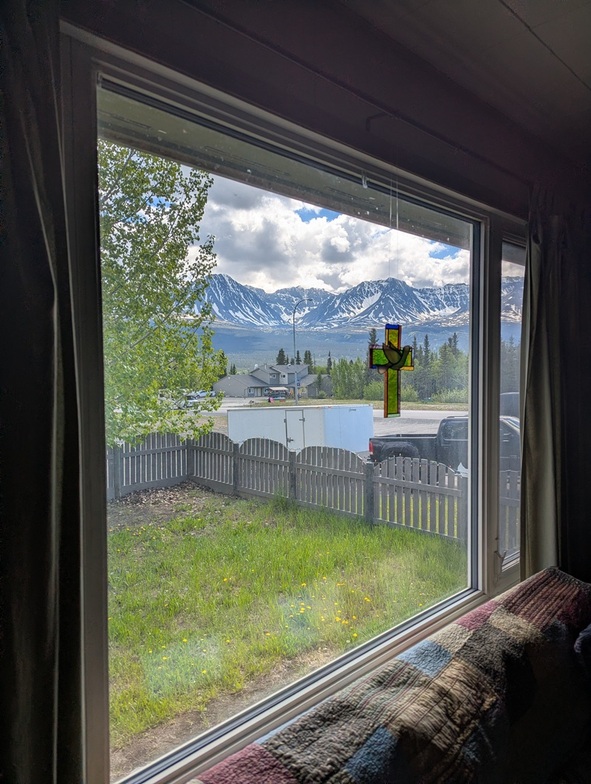
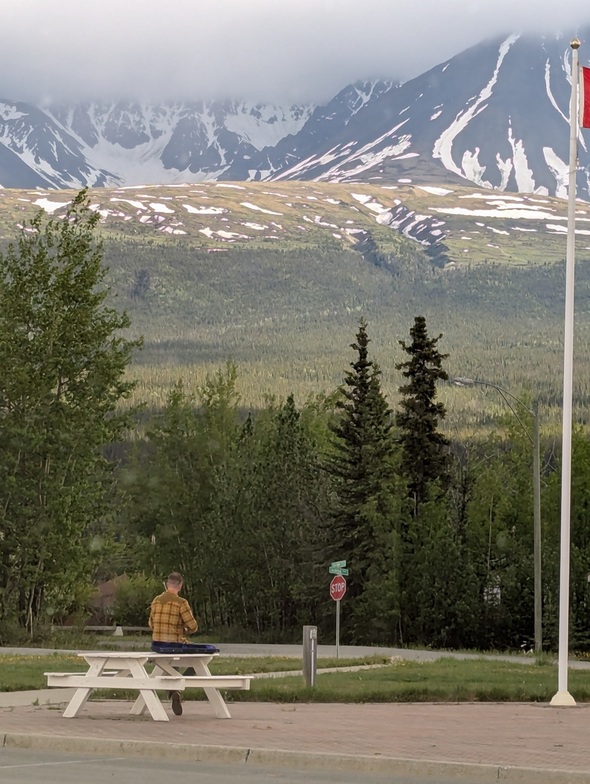
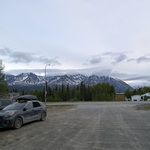
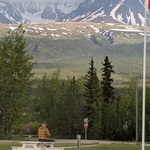
We arrived and got settled at the former bishop’s rectory in town, and I ventured outside to stare gobsmacked at the mountains which hug the southwest corner of the town. At the Kluane National Park and Reserve Visitor Centre, loads of information on the Indigenous peoples of the area was on display, from time immemorial to contact and beyond.
Wandering into an area of the centre with massive floor to ceiling windows that offered an even more beautiful view of the range, I was more gobsmacked than ever to realize that those mountains – Mount Cairnes, Archibald, Martha, Kathleen, and Dalton Peak – were only the first gateway into Kluane National Park, which was pictured on a topographical map in one room, showing me the absolutely dizzying height of the peaks to the southwest. On this map, the mountains I just named were barely a bump. Mount Logan, Canada’s tallest mountain and the second tallest in North America, was superb to behold just on the map itself, when one imagined the whole thing “to scale.”
Judy and I enjoyed a delectable lunch at Frosty’s, the local burger and ice cream joint, then went to pick up our tickets and mingle as guests began to arrive. It only took about fifteen minutes before we were singing “O My Darling Clementine” with a couple of other folks who had set up in front of the conference centre where the main stage was to be held.
Before long, it was time to begin! We moved back and forth between the main stage and the church itself, where it was quite a treat to watch these groups move from bigger “arena”-type energy in their sets to smaller and more intimate tunes and tones.
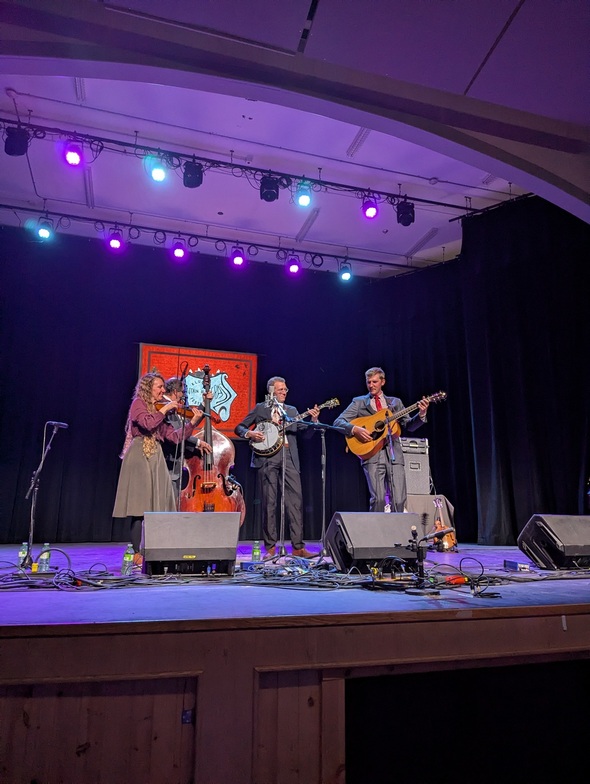
Although this particular festival – “the only bluegrass festival north of 60!” – is called a bluegrass festival, Rick told me that over the years it loosened its boundaries, now including old time, folk, and roots. Bluegrass purists (I overheard several) bickered amiably about what songs could be slotted into which categories, although plenty of musicologists will tell you the lines are blurrier than most would care to think. 2026 included groups like Tennessee’s High Fidelity (who could have stepped right out of O Brother, Where Art Thou?), Florida’s Remedy Tree (more of a punk edge, and I have never seen anyone play mandolin like Bryce Griffin; the only appropriate word for what he did was “shred”), and Ontario’s The Barrel Boys (bluegrass harmonies belted into the microphone in a football huddle), Shari Ulrich and the Unfaithful Servants (a dream of a super group), and North Carolina’s The Burnett Sisters Band (outfitted in truly Instagram-worthy Christian homesteader chic), all of whom had the sort of sounds I expected to hear. But the line-up also included Cape Breton’s Cassie and Maggie (who lit up the stage with east coast fiddle tunes, dancing, and a genius mash-up of “Bury me beneath the willow” and “Walkin’ after midnight”), and BC group The Fugitives. I’d called Cassie and Maggie traditional and the Fugitives roots, but both were welcomed and appreciated. Several other more local groups rounded out the line-up.
I’d originally thought to dive into the theology behind bluegrass, and so I’ll say that one of the reasons I love it so is what I might call a ragged commitment to reality. I found myself particularly drawn to it during lockdown, when there wasn’t much to do but practice my dad’s mandolin and lean into the weirdly comforting pathos of “Will the Circle Be Unbroken,” “Down in the Valley,” “A Flower Blooming in the Wildwood,” and “Gallows Pole.” Here was music that wasn’t afraid to lament with its whole chest, and usually in only three or four chords to boot.
But in the end, I didn’t have to do much research, because I had a deeply spiritual experience right there in the church – which the following Sunday’s service brought into sharp focus for me, and drew a new song of my own, “Perfect Offering,” out of me, which I shared at the Whitehorse Worship Arts and Music Festival a couple of weeks later.
The last show of the night on Friday found me in St. Christopher’s listening to The Fugitives. At one point, one band member began to introduce a song that they’d written about a friend who had since died. He took a sip from the beer can in his hand...then placed it on the altar, next to a line of water bottles I hadn’t noticed until then. On the credence shelf next to it, I also saw they’d put their picks and other little tools for the show.
Being an Anglican priest, I winced. Sir this is not just a table! But no one knew I was a priest, and no was there for church. They were there for a bluegrass concert, and if I hadn’t been there, probably no one would have cared.
“For them, it’s just a table,” I said to myself, “and it’s not being used for anything else at the moment, so let it ride. Besides, didn’t St. Brigid herself call for a lake of beer for the King of Kings?”
That was all it took for my mind to start spinning, as it does.
Well, they need that water to keep their voices fresh. They need those little tools to do the work. And, as I listened to the fellow talk of the friend they’d lost and memories of watching the Northern Lights with him, I thought, “Heavy stuff. And this guy’s in front of a lot of people. A can of beer (responsibly portioned!) helps take the edge off, I reckon.
“It’s such lovely music they’re sharing with us. There’s some beauty there that God would surely appreciate. Beer on the altar is cool by me.”
As the show came to an end, they introduced another song, words largely improvised, about all of the tiny annoyances of life, and how enduring them kept us humble and grateful for happier times. The last chorus, which was taught to us so we could sing along, was “All this trouble in the world: let it come.” At the tail end of the song, we began to sing it over and over, like a Taizé chant, and I, with a beautiful but heavy year on my heart, fully leaned into it just as I would any prayer chorus, thrilling in the occasional cry of encouragement from the band leader: “Come on! Again! Pick it up!”
The next day, Rick, Judy, and I gathered for Morning Prayer at the very same church. There were no beer cans on the altar. Rick and Judy and I piously sang “Bright Morning Star a’rising,” “Leaning on the Everlasting Arms,” and a truly goosebumpy “Amazing Grace” which Rick lined out in true Isle of Lewis/Appalachian fashion. During the sermon (“The harvest is plentiful, but the labourers are few”), the lay preacher said, “Even Jesus needed help with the work.”
The Holy Spirit whispered into my ear: “It’s not just the harvest that goes on the altar. It’s the tools as well.”
I thought of that beer can, and the music that touched all of us gathered in the little church, last night and this morning. I thought of sheaves of wheat and the sickle that cut them being offered up; of music ringing out in a church and the tools required to produce it laid upon the altar. I thought of how that evening show felt like a sister to the morning ritual we were enjoying right now.
And I thought, “Isn’t this just what humanity is about: moments like this, singing with voices braided together like sweetgrass, coffee and cream, whiskey and soda; moments like this cradled by wooden roofs or mountains or oceans or a wide prairie sky; moments like this when variegated voices somehow become one.”
Photos:
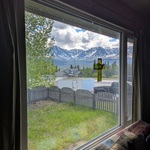
- View of the mountains bordering Kluane Mountain National Park and Reserve, from the bishop's home in Haines Junction
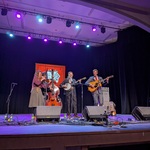
- Tennessee-based group High Fidelity on the main stage
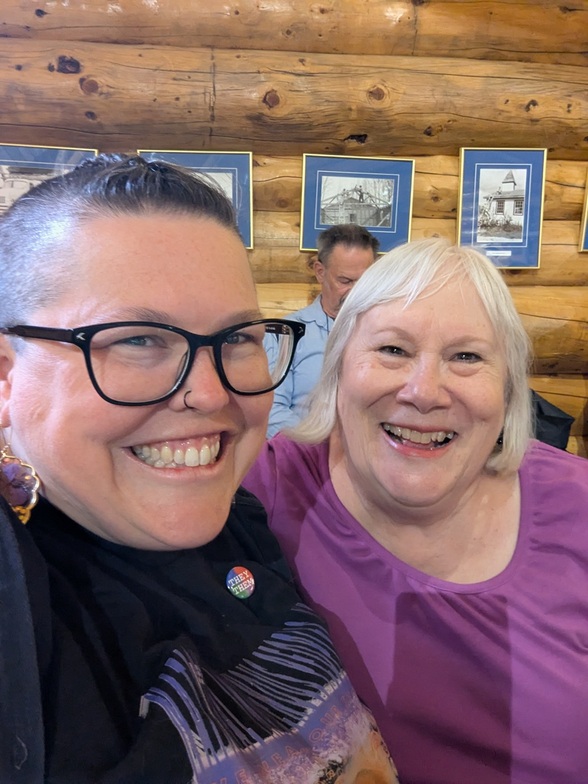
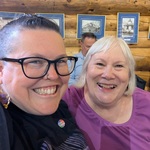
- Judy Greenhill and I just about to sit in on a bluegrass harmonies workshop led by Ontario-based group The Barrel Boys
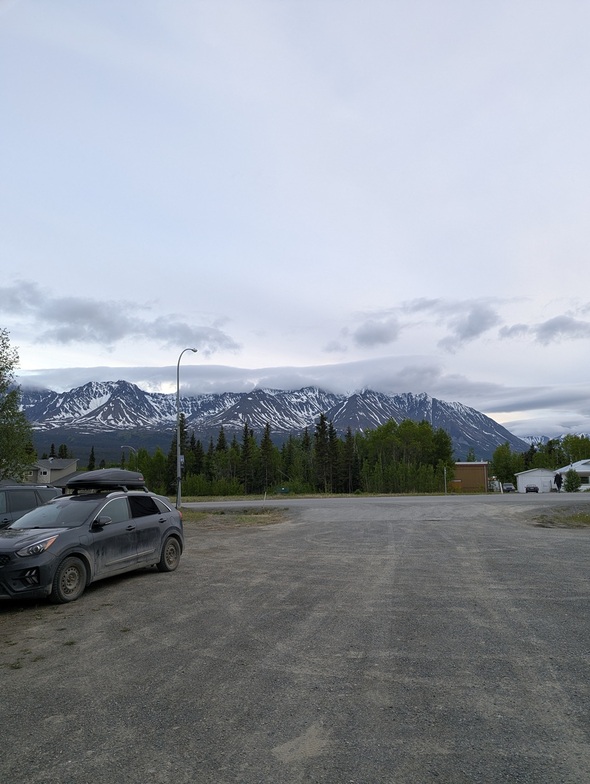
- 11pm in Haines Junction
- "Your perfect offering"; member of one of the groups (maybe Remedy Tree) playing fiddle in God's masterpiece