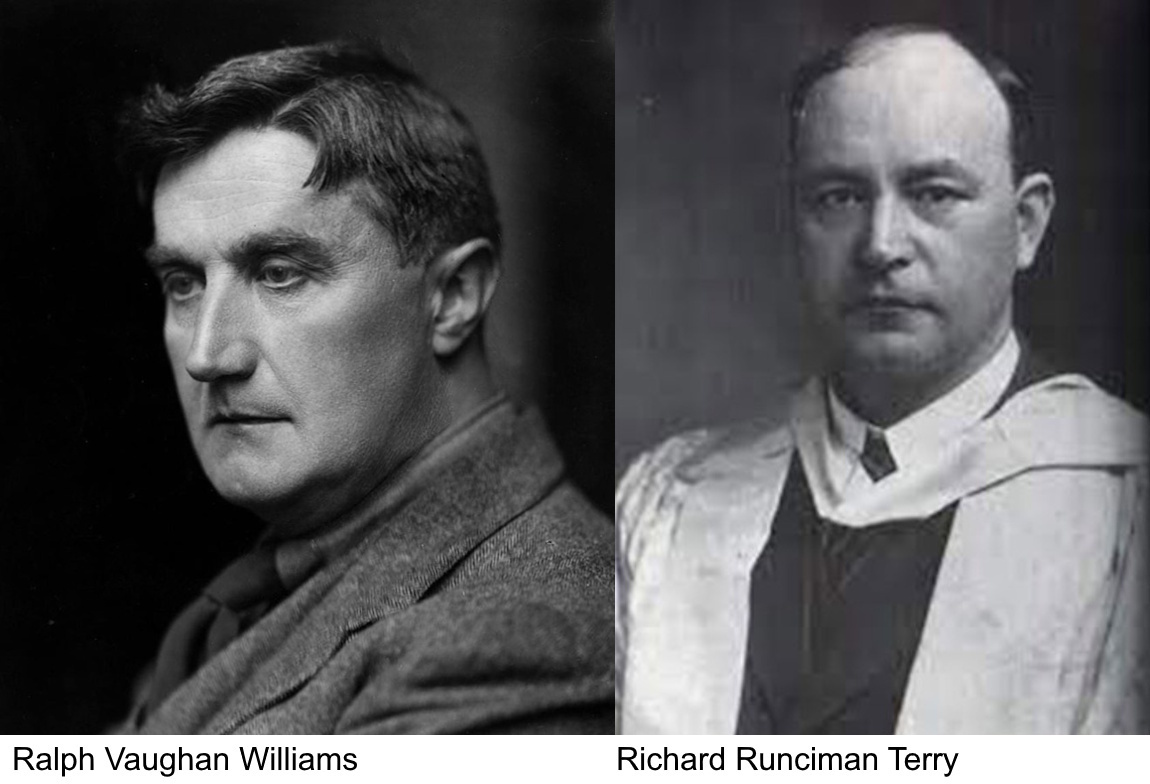
When Ralph Vaughan Williams (1872-1958) began composing at the beginning of the twentieth century the musical traditions of his own country were moribund. “A land without music” in the derisive words of Oscar Schmitz, England’s last great native composer had been Purcell in the seventeenth century, and serious music was Teutonic in derivation. The impetus of nationalism, both political and musical, was strong and the composers of many countries sought to create specifically national musics, often starting with folk idioms as a basis.
Vaughan Williams immersed himself in English folksong, both as a collector and composer. However, an even stronger influence came from the tradition of Tudor polyphony, much of which was being performed again for the first time since the Reformation. One result of the restoration of the Catholic hierarchy in England was the construction of Westminster Cathedral, which opened in 1903. The first director of music was Sir Richard Runciman Terry, who developed a repertoire for the choir centred on the Renaissance polyphonists – Palestrina certainly, but also Englishmen such as Taverner, Tye, Tallis, Sheppard, and Byrd. The nation’s Tudor musical heritage was thus made available and served as a catalyst for many, Vaughan Williams in particular.
The Mass in G minor was written in the early years of the 1920s, dedicated to Gustav Holst and his Whitsuntide Singers, and first performed in December of 1922. It is scored for double choir and solo quartet, which mirrors the distribution of forces in the seminal Fantasia on a Theme of Thomas Tallis (1910). The mass is steeped in the idiom of the Tudor polyphonists but this is no mere pastiche. Vaughan Williams integrated technical elements of the period (Renaissance counterpoint, modality, false relations) with his own compositional style to produce a unique, specifically English identity, already evident in the Tallis Fantasia. Terry, who gave the first liturgical performance of the mass at Westminster Cathedral in 1923, was well pleased: “I’m quite sincere when I say that it is the work one has all along been waiting for. In your individual and modern idiom you have really captured the old liturgical spirit and atmosphere.”