What If God Doesn’t Want to Fix Us?

This post is based upon the 40 min Forum I presented on Sunday, September 27, 2026.
One of the most significant Anglican theologians working today joined us at Christ Church Cathedral on Sunday, October 4, 2026. The Reverend Dr. Sam Wells, Vicar of St. Martin-in-the-Fields in London, has spent much of his ministry exploring a question that sounds deceptively simple: What if the heart of Christianity is not primarily what God does for us, but God’s desire to be with us?
That small change in preposition, from for to with, has profound implications for how we understand God, the purpose of the Church, and our relationships with one another.
Wells is an unusual combination of academic theologian, Christian ethicist, parish priest and public intellectual. He has written approximately fifty books, held a professorship at Duke University, and served as Dean of Duke Chapel before returning to England in 2012 to become Vicar of St Martin-in-the-Fields in Trafalgar Square. He is also Visiting Professor of Christian Ethics at King’s College London.
Yet what makes his theology particularly compelling is that it has emerged not simply from academic reflection but from the experience of parish ministry, including years spent alongside communities experiencing poverty and marginalization. His work moves continually between theology and practice, asking what the Christian story means for the actual lives of people and communities.
I want to explore several themes in Wells’s theology, particularly those that might help us think more deeply about our own vocation as a cathedral in the heart of Vancouver.
What Is Christianity Actually About?
Christians have often told the story of their faith as a problem followed by a solution. God creates humanity, humanity falls into sin, sin separates us from God, and God sends Jesus Christ to redeem us. Through the cross and resurrection, humanity is forgiven and restored to relationship with God.
There is nothing inherently wrong with this account. Sin, forgiveness, reconciliation and redemption are central to the Christian faith. But Wells challenges us to consider whether, in telling the story this way, we have inadvertently made human failure the organizing principle of Christianity.
If the entire purpose of the incarnation is to repair the damage caused by sin, then God’s decision to become human is essentially a response to something that has gone wrong. The incarnation becomes a divine rescue operation.
But what if God would have become incarnate even if humanity had never sinned?
This is not a new theological question. It has occupied Christian thinkers for centuries, particularly within the Franciscan theological tradition. Yet Wells brings it into contemporary conversation with considerable force.
What if God’s fundamental purpose in creation was always communion? What if God creates not because something is missing in the divine life, but out of an abundance of love that desires to be shared? What if the incarnation reveals not simply God’s solution to human sin, but something fundamental about God’s very nature?
In this understanding, Christianity begins not with human deficiency but with divine abundance. God does not first encounter a problem that needs solving. God desires relationship, and creation itself is an expression of that desire.
The implications are considerable. Salvation becomes something larger than the forgiveness of individual sins or the promise of heaven after death. It is about God’s desire to draw the whole creation into communion with the divine life.
And this brings us to one of the most distinctive features of Wells’s theology: his insistence that the little word with lies at the heart of the Christian story.
The Importance of Nazareth
Consider how we ordinarily tell the story of Jesus.
We concentrate on his birth, his public ministry, his teaching and miracles, his confrontation with religious and political authorities, and ultimately his death and resurrection. These are the events that fill our Gospels, shape our liturgical calendar, and occupy most of our preaching.
Yet Jesus spent perhaps thirty years living in Nazareth and only three years in what we normally describe as his public ministry.
We know remarkably little about those thirty years. Consequently, we tend to treat them as preparation for the important things that came later. Nazareth becomes the waiting room before Jesus begins his real work.
Wells asks us to reconsider that assumption.
What if those hidden years were not simply preparation for God’s work but were themselves an essential expression of that work?
For thirty years, God lived an ordinary human life. Jesus grew up in a family, worked, ate meals, formed friendships, participated in the life of a community, and experienced the rhythms and limitations of human existence. There were no crowds gathering to hear him preach, no dramatic miracles, no great public confrontations. Yet God was present, sharing the ordinary circumstances of human life.
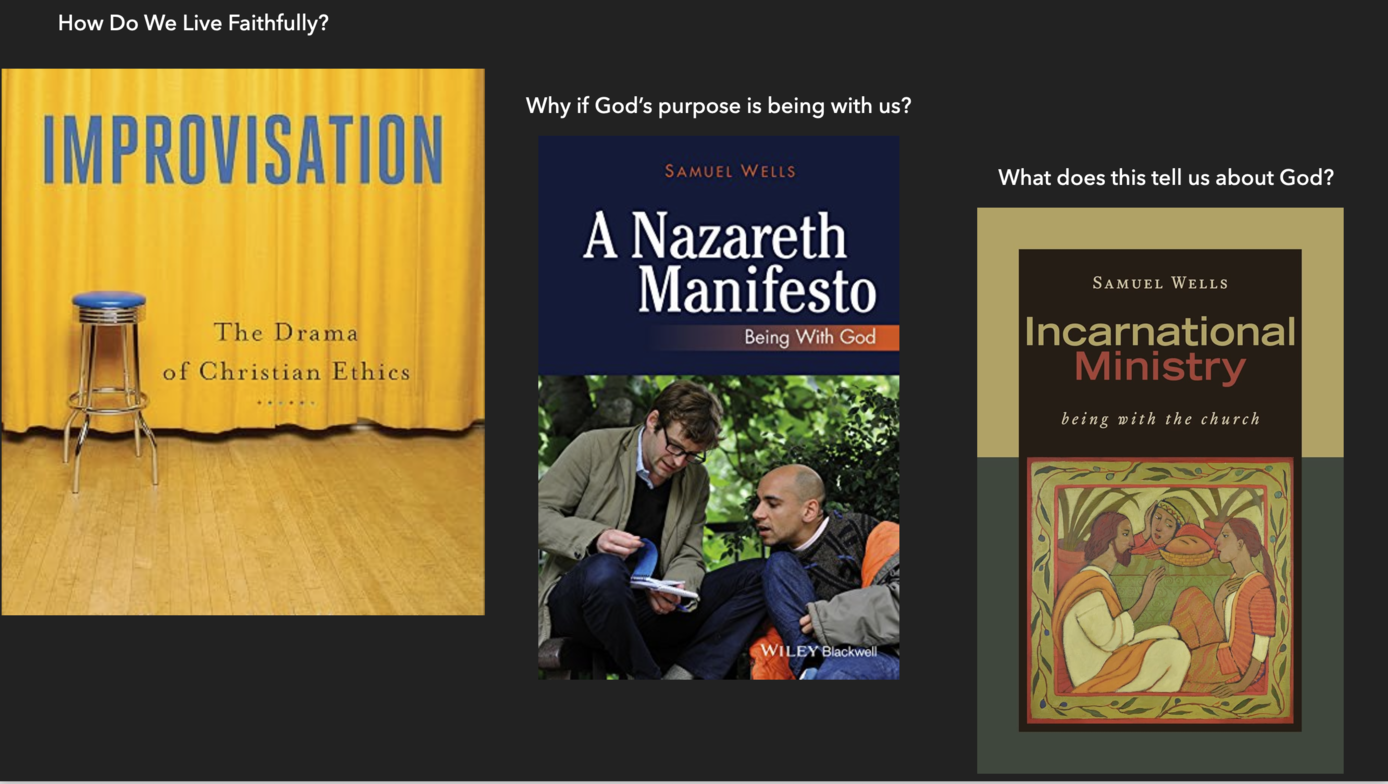
This is the central insight of Wells’s A Nazareth Manifesto. The years at Nazareth reveal something fundamental about the incarnation. God’s purpose is not exhausted by dramatic acts of intervention or redemption. God comes to dwell with humanity.
The name Emmanuel, God with us, becomes more than a description of the Christmas story. It becomes a way of understanding the whole Christian narrative.
Indeed, when we look again at Jesus’ public ministry, we discover that much of it is characterized by this same quality of presence. Jesus eats with people, walks with them, visits their homes, attends celebrations, accepts interruptions, and weeps with friends. He shares tables with those whom respectable religious society would prefer to exclude.
Certainly, Jesus heals, teaches, challenges and liberates. But his ministry cannot be reduced to the things he accomplishes. His presence among people is itself a revelation of God.
This matters because we often assume that presence is what remains when there is nothing useful left to do. We visit someone who is dying, knowing that we cannot cure them. We sit with someone who is grieving, recognizing that no words can remove their loss. We accompany those whose circumstances seem beyond our capacity to change.
We sometimes describe these moments as occasions when all we can offer is our presence.
Wells would invite us to see them differently. Presence is not a lesser form of ministry, something we offer when practical solutions are unavailable. Being with another person is itself a participation in the life and purposes of God.
From Doing For to Being With
This theological conviction has important implications for Christian mission and social ministry.
Churches have a long and honourable history of responding to human need. We feed the hungry, shelter the homeless, care for the sick, advocate for justice, and support those who are vulnerable. These activities are indispensable expressions of Christian discipleship, and Wells is certainly not suggesting that we should abandon them.
But he does ask us to examine the relationships that such activities can create.
When we organize our ministry primarily around doing things for other people, we can unintentionally establish a distinction between those who possess resources and those who need them. One group becomes the giver and the other the recipient. One has gifts to offer; the other is defined by what is lacking.
Even when motivated by genuine compassion, this can reinforce patterns of dependency and inequality.
Wells explores several ways of relating to others, including working for, working with, being for, and being with. Each has its place. There are circumstances in which love requires decisive action on another person’s behalf, just as there are times when advocacy and practical assistance are essential.
But being with another person introduces something different.
Rather than defining the relationship primarily through a problem that needs to be solved, we begin with the possibility of friendship, mutuality and shared life. We discover that each person has gifts to offer and needs to be met. Those who arrive seeking assistance may also have something profound to teach us about faith, resilience, generosity and the presence of God.
The relationship changes because we are no longer simply providers and recipients of services. We become people whose lives are enriched and transformed through our encounter with one another.
Charity begins to become communion.
This is not an argument against effective social programmes or professional competence. It is an invitation to consider whether our practical ministries emerge from, and ultimately lead toward, relationships of genuine mutuality.
What Might This Mean for Christ Church Cathedral?
One reason I find Wells’s theology so compelling is that his ministry at St Martin-in-the-Fields raises questions remarkably similar to those we face at Christ Church Cathedral.
St Martin’s occupies one of the most prominent church locations in the world, overlooking Trafalgar Square. It is simultaneously a place of Christian worship, a centre for music and cultural life, a significant tourist destination, a centre of social enterprise, and a community deeply engaged with people experiencing homelessness.
These activities might easily be understood as separate programmes competing for the attention and resources of a single institution.
Yet Wells’s theology invites another possibility. What if these apparently different activities are not simply things the Church happens to do, but different expressions of the common life of one Christian community?
At Christ Church Cathedral, we are continually negotiating similar questions.
We are a worshipping congregation, a centre for music and the arts, a historic landmark, a gathering place for the city, and a community committed to social justice and pastoral care. Through initiatives such as Maundy Café, our refugee ministry, and our many partnerships, we seek to respond to the needs of those around us.
Like St Martin’s, we also face the practical realities of maintaining a significant historic building, sustaining a complex organization, and finding the financial resources necessary to support our mission.
It is tempting to regard these as competing responsibilities that must somehow be balanced. We speak of our liturgical life, our outreach, our cultural programming, our congregational development and our financial sustainability as though they belong to different categories.
But perhaps a more fruitful question is whether these different dimensions of Cathedral life might together reveal something about the nature of Christian community.
Consider the distinction between saying that we have a ministry for people experiencing homelessness and saying that our Christian community includes people experiencing homelessness.
The first describes an institution that provides assistance to a particular population. The second describes a community in which people encounter one another as participants in a shared life.
The difference is subtle, but the implications are profound.
We might ask ourselves not simply how many people we serve, but how deeply our lives are connected with theirs. Who sits at our tables? Whose gifts help shape our common life? Who influences our decisions? Who changes our understanding of what it means to be the Church?
And perhaps most importantly, are those who encounter the Cathedral through our social ministries, musical offerings, hospitality and cultural activities always understood as people to whom we minister, or might they already be participants in the broader life of this Christian community?
These questions are not easily answered. Nor should we pretend that the distinction between doing for and being with can simply be resolved through a change in language. Genuine mutuality requires time, trust, humility and a willingness to be changed ourselves.
Nevertheless, Wells offers us a compelling way of thinking about our vocation as a cathedral in a largely secular city.
Our calling may be less about persuading people to enter an institution we have already constructed and more about discovering how God is bringing a community into being through the relationships we share.
Learning to Improvise
Another important strand of Wells’s theology helps us consider how the Church might respond faithfully to a rapidly changing world.
In his influential book Improvisation: The Drama of Christian Ethics, Wells proposes that Christian discipleship can be understood through the analogy of theatrical improvisation.
Christianity, in this account, is not primarily a set of propositions to be affirmed or a collection of rules to be obeyed. It is a story that we learn to inhabit.
We know much of the story already. We know about creation, the calling of Israel, the life and ministry of Jesus, the cross and resurrection, and the emergence of the Church. Above all, we know the central character, Jesus Christ, and we have been given a vision of the ultimate fulfilment toward which the story is moving.
But the Church has not been given a script for every scene.
Scripture does not tell us precisely how to be an Anglican cathedral in Vancouver in 2026. It offers no detailed instructions for navigating secularization, artificial intelligence, climate change, reconciliation with Indigenous peoples, or the extraordinary social and economic pressures shaping contemporary urban life.
We cannot simply reproduce the circumstances of the first century. Nor can we abandon the Christian story and invent something entirely disconnected from it.
We must learn to improvise faithfully.
Anyone familiar with jazz will recognize the distinction between improvisation and simply making things up. A skilled jazz musician can improvise precisely because the music has become so deeply embedded in her imagination and practice. She understands its harmonies, rhythms, structures and traditions. That familiarity gives her the freedom to respond creatively to something new without losing her connection to the music itself.
Christian formation works in much the same way.
Through Scripture, worship, prayer, community and the practices of discipleship, we become increasingly familiar with the character of God and the shape of the Christian story. Over time, we learn to recognize what faithful participation in that story might look like when we encounter circumstances that previous generations could scarcely have imagined.
The question becomes not simply what rule should be applied, but what action would be consistent with the character of Christ and the story we have been given.
What would faithfulness look like in the next scene?
This seems particularly important for churches seeking to discern their mission in a time of considerable institutional and cultural change. We often find ourselves caught between the desire to preserve inherited patterns and the pressure to embrace whatever seems new or innovative.
Wells offers a more demanding alternative. Faithful improvisation requires both a deep immersion in Christian tradition and the imaginative courage to respond creatively to the present.
It is neither nostalgia nor novelty for its own sake. It is the continuing work of discerning how the story of Jesus Christ is to be lived here and now.
A Theology of Communion
Across his writing, Wells has developed these themes into an increasingly comprehensive theological vision.
His earlier work on improvisation explores how Christians learn to act faithfully within God’s story. A Nazareth Manifesto places the incarnation and the significance of being with at the centre of Christian mission. His more recent Constructing an Incarnational Theology, published in 2025, begins to develop these insights into a broader account of Christian doctrine.
What emerges is a way of telling the Christian story in which communion, rather than human failure, becomes the central organizing theme.
God creates out of love and abundance. The incarnation reveals God’s desire to share our life. The ministry of Jesus demonstrates what that shared life looks like. The cross and resurrection overcome everything that threatens or destroys communion. The Eucharist gathers us into the life of Christ and one another. And the Christian hope looks toward the fulfilment of creation in the presence of God.
This does not diminish the seriousness of sin or the significance of redemption. Rather, it places them within the larger purposes of God.
Sin is devastating precisely because it fractures the communion for which we were created. Redemption matters because it restores and transforms that communion. The ultimate purpose of salvation is not simply to rescue individuals from a fallen world but to bring creation into the fullness of life with God.
For the Church, the implications are both comforting and challenging.
If God’s fundamental purpose is communion, then the mission of the Church cannot be reduced to institutional survival, numerical growth, the delivery of social services, or even the proclamation of religious ideas.
These things may all have their place, but none can substitute for the deeper calling to become a community whose common life reveals something of God’s desire to be with the world.
That is a considerably more demanding vision of Christian mission because it asks not simply what we accomplish but who we are becoming.
The Church We Are Called to Become
Following the visit of the Rev. Dr. Sam Wells to Christ Church Cathedral, I hope we will wrestle not simply with his ideas about contemporary Christianity, but for the vision of God that animates his theology.
It is a vision that challenges our tendency to measure the significance of ministry through activity, achievement and outcomes. It reminds us that the ordinary practices of friendship, hospitality, attention and shared life are not incidental to the Gospel. They are among the ways in which the Gospel takes flesh in the world.
It also challenges us to think beyond the familiar divisions between worship and mission, congregation and community, sacred and secular, giving and receiving.
Perhaps the most important question facing a cathedral like ours is not simply how we attract more people, expand our programmes, maintain our building, or secure our future, important though those responsibilities may be.
Perhaps the deeper question is what kind of community we are being called to become.
What would it mean to be a cathedral whose life is shaped by God’s desire for communion? What might change if we understood those who enter our doors, whether for worship, music, a meal, a moment of silence, or simply to escape the rain, not primarily as visitors or recipients of our hospitality, but as people with whom God may already be inviting us into relationship?
And what might happen if we allowed those relationships not only to extend our mission but also to transform our understanding of ourselves?
At the heart of the Christian story is a God who does not remain at a safe distance from creation, offering assistance from afar. It is the story of a God who enters human life, shares its joys and sorrows, embraces its vulnerability, and remains with us even through suffering and death.
Emmanuel. God with us.
If that is what God is like, then perhaps the most important question for the Church is whether our own common life is beginning to look something like that.
It is a question worth asking, as we continue to discern what Christ Church Cathedral is called to be in the heart of Vancouver.