Christ Church Cathedral Vancouver — A Cathedral for the City

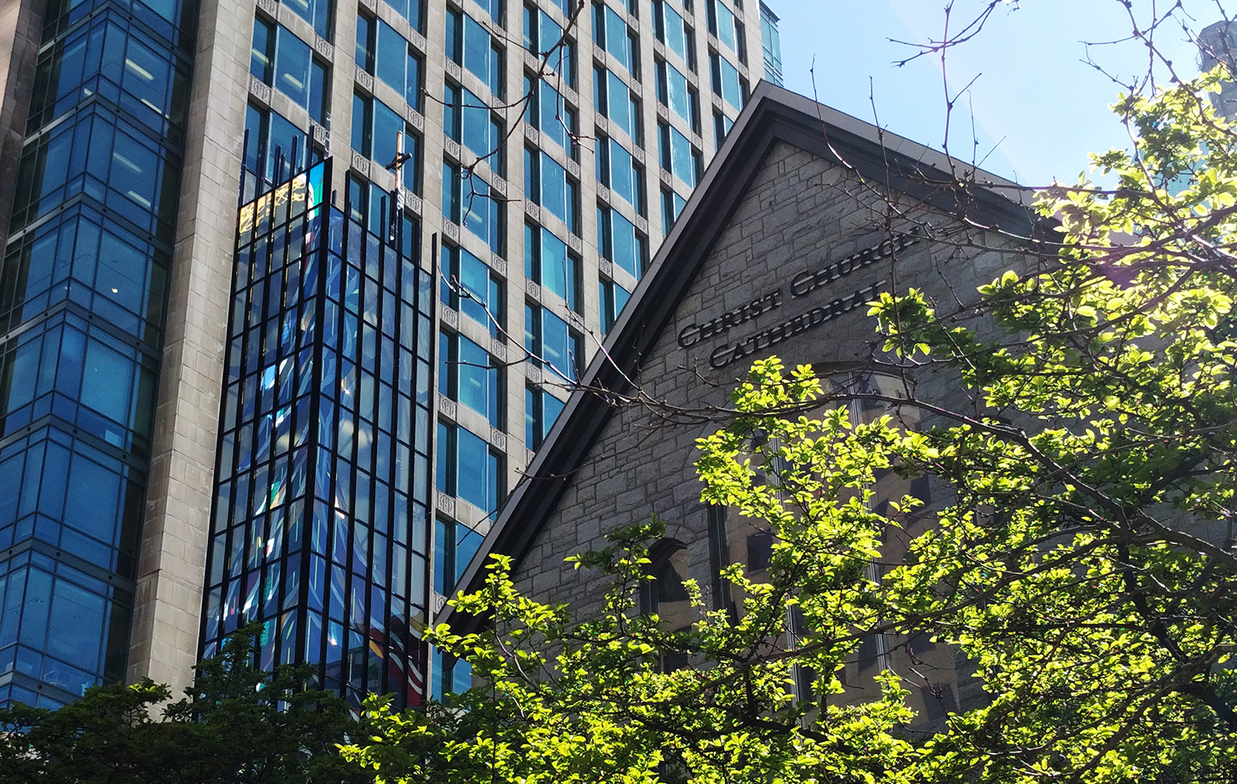
A cathedral is not simply a larger parish with more moving parts. It is a public church. It belongs, in a particular way, to the whole city.
Our own website names this plainly: “The Cathedral is not only a place you attend, but a place that attends to the world.” And in another place we describe our identity as three-in-one: parish church, diocesan cathedral, and cathedral for the city—a place of welcome for Metro Vancouver and the Lower Mainland, whether someone is “rooted in faith or just beginning to explore it.”
That is not branding. It is vocation.
What is becoming clearer in this season is a renewed commitment to that deepest vocation: to be a church for the whole of Vancouver. For those who come every Sunday and those who come only at Christmas and Easter; for those who come for music, for a funeral, for a candle, for the blessing of animals; for those who come for a concert and for those who slip in midweek simply to sit in silence.
We are here as well for those who never claim a religious identity, or who are of another faith tradition.
This is deeply Anglican. Our tradition has long been shaped by the parish ideal: the care of souls for everyone within our reach. The Anglican instinct is not coercion; it is space—prayer, beauty, silence, preaching, and the sacraments offered freely. We trust that God is already at work in people before they arrive and continues to work long after they leave.
In one of my reflections, I called this the “three cathedrals” reality, and I described the city-calling this way: the Cathedral as a centre of public space—a safe place where people come “seeking refuge… a place to heal, to find sustenance, community or Jesus,” and a place where we can “optimize for the common good.”
That image is not theoretical. We have watched it happen: weekday doors open; the Maundy Café; public office hours; students and seekers; neighbours carrying grief; visitors carrying questions; and the surprising range of people who claim this place as home—including those from many faiths and no faith, and those connected with the regiments.
And that leads to the point of a vestry charge: vocation must become action.
The Anglican “why” we must not forget
Former archbishop of Canterbury William Temple famously said that the Church is “the only organization that exists solely for the benefit of non-members.” That is the cathedral logic in one sentence: we exist for the city as it is, not as we wish it were.
Former Archbishop of Canterbury Michael Ramsey, so deeply Anglican, and so deeply catholic, kept insisting that the Church only becomes truly itself when it lives under the shape of Jesus Christ crucified and risen: reconciled, humble, faithful, and refusing the smallness of factional “isms.” In a time when public life is fragmenting, the Cathedral has to be a place where people can breathe again and where the Church offers a credible, living sign of communion.
And Archbishop of York Stephen Cottrell’s language is bracingly practical: prayer is not merely spoken; it is lived. “The Lord’s Prayer isn’t just a guide for prayer, it’s an invitation to live differently.” Or, as he put it in an Easter reflection, resurrection life calls us to “loving action, positive change and inner transformation.”
William Temple gives us the outward-facing purpose. Ramsey gives us the cruciform depth and theological coherence. Cottrell gives us the lived, public traction.
So: what does this mean for us in 2026?
Our calling remains both simple and demanding
If we are to be a cathedral for the city, then we must be:
- Unmistakably a place of prayer—for Vancouver, for the nations, for those who cannot pray.
- A home for worship that is reverent, ordered, and alive—beautiful enough to carry the weight of human life, honest enough to make room for doubt.
- A place of public meaning—where we speak with clarity to moral and spiritual questions, without collapsing into partisan noise.
- A house of care and welcome—for neighbours, pilgrims, artists, students, seekers, and strangers.
- A community that turns faith into action—not as an “extra,” but as the natural overflow of the Eucharist.
This is why, in my vestry letter of 2024, I spoke directly about building for God’s Peaceable Realm through action and advocacy, naming realities we cannot romanticize away: refugees fleeing violence, the scourge of drug overdoses, and the housing/homelessness crisis. That wasn’t a phase. It is part of what it means to be a public church in the heart of Vancouver.
Five commitments for 2026
Here is the charge I want to place before this Vestry; not as a wish-list, but as a shared rule of life for a cathedral that means what it says.
1) Keep the Cathedral a house of prayer: open, steady, and non-anxious.
Our first gift to the city is spiritual: prayer, silence, intercession, and the worship of God. This is not escapism. It is the deep engine of courage and generosity. We should protect the stability and excellence of Sunday worship, and we should keep strengthening weekday prayer as a visible offering to the city.
2) Practice intentional, public welcome.
“A cathedral for the city” cannot be true only on Sundays. It must be true on ordinary weekdays, when people wander in carrying private burdens. Our posture must be: come in; you are safe; you do not need to perform; you may sit; you may pray; you may simply be.
3) Make room for the city’s languages and cultures as a spiritual act of hospitality.
One concrete sign of this in 2026 is our new weekly French Eucharist, beginning Sunday, February 22, 2026 at 5:30 pm, and our Prayer Service for Iranians on February 15, 2026 at 4 pm. This is exactly the sort of cathedral ministry that says: we are here for the whole city, and we will meet our neighbours with dignity and joy.
4) Hold together beauty, formation, and public meaning.
Our music, preaching, teaching, and public events are not “add-ons.” They are part of how a cathedral speaks to the city through beauty that disarms, through thoughtfulness that respects the mind, through faith that does not fear contemporary questions. (This is already embedded in how we describe our life together: worship, justice, beauty, and thoughtful faith meeting the life of Vancouver.)
5) Turn Eucharist into credible service: the Peaceable Realm in local form.
In 2026 we must keep asking: Where is the suffering, confusion, and fatigue of this city and how is Christ calling us to respond with tangible care? That means steady attention to food security and poverty, to those displaced or newly arrived, to those harmed by addiction and its related crises, and to the quiet forms of loneliness that are everywhere in an expensive, pressured city. This is not “activism.” It is worship lived outward.
The specific ask of this Vestry
Vestry exists to help this vocation become durable; spiritually, financially, and operationally. So my direct charge to you is this:
- Make decisions that protect the Cathedral’s public calling, not merely internal comfort.
- Invest in ministries that keep the doors open—literally and spiritually.
- Strengthen the systems that support welcome, safety, pastoral care, and excellence in worship.
- Hold us accountable to measurable action, without losing the soul of prayer.
If we do this well, Vancouver will continue to experience Christ Church Cathedral as what it is called to be: not a private club for the convinced, but a living church at the crossroads of faith and city life—where heaven and earth touch, where the Gospel is proclaimed in word and sacrament, and where the common good is pursued with humility and courage.
That is a cathedral for the city.
And that is the work in front of us in 2026.