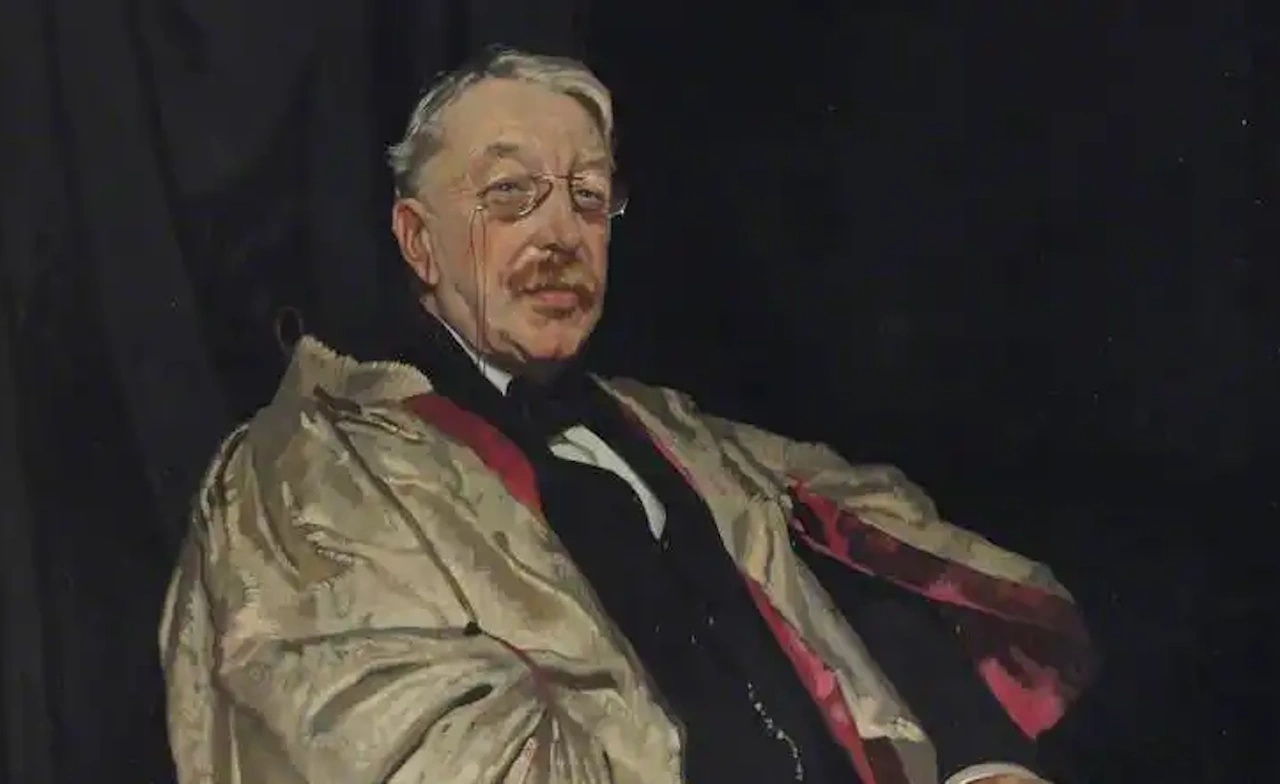
This Easter Sunday, the setting of the Gloria is by the imposingly-named Sir Charles Villiers Stanford (1852-1924). Born in Dublin, Stanford studied at Cambridge and Trinity College in London before further studies in Germany with Carl Reinecke and Friedrich Kiel. A founding professor of the Royal College of Music, he taught composition there from 1883 until his death, also at Cambridge University from 1887 onwards. Stanford was legendary for his temper and unorthodox teaching methods: his criticism consisted for the most part of “I like it, my boy,” or “It’s damned ugly, my boy” (the latter in most cases). Nevertheless, his pupils included virtually the whole next generation of British composers, including Ralph Vaughan Williams, Gustav Holst, Herbert Howells, John Ireland, Ivor Gurney, Charles Wood, and Sir Arthur Bliss.
In his own compositions Stanford made overt use of Irish traditional elements, yet with a few exceptions (The Blue Bird and Drake’s Drum) they mostly have not entered the standard repertoire. “Too Irish for the English, too English for the Irish and too German for both, he fell between all stools.” The big exception is his works for the Anglican church, which have been a staple in services ever since their composition. Last June the choir sang Stanford’s Te Deum in B-flat, which has a long history at Christ Church. Composed in 1879, it was part of the music for the coronation of King Edward VII in 1902. Nine years later, for the investiture of the next monarch King George V, Stanford was commissioned to write a Gloria. The result, for voices, semi-chorus, soprano solo and orchestra, was published as part of his Festal Communion Service in B-flat, Opus 128. The Gloria, with organ or orchestral accompaniment, became popular as a separate piece, and was subsequently also included in the coronations of King George VI in 1937 and Queen Elizabeth II in 1953; the BBC TV broadcast of the latter performance can be found on YouTube.