Whitehorse Recap - Indigenous People's Day

It was a very warm and hazy solstice morning as I ventured forth to the Kwanlin Dün Cultural Centre in Whitehorse for the National Indigenous People's Day celebrations.
The Kwanlin Dün First Nation includes people of Southern Tutchone, Tagish, Tlingit and many diverse backgrounds. They acknowledge the Tagish Kwan as the original dwellers on the land. When visiting the MacBride Museum, we found ourselves at the pre-contact exhibit by a large poster welcoming us in seven languages: Gwitch'in, Hän, Northern Tutchone, Southern Tutchone, Tagish, Tlingit, and Upper Tanana. The name of the nation comes from the Southern Tutchone name for the area, Kwanlin, "running water through canyon," referring to the waterway now known as Miles Canyon. There is evidence of the ancestors from at least the last ice age in the form of stone tools. Like certain parts of Coast Salish territory, the headwaters of the Yukon River were a gathering place for a multitude of nations, many of which were nomadic and would follow migratory patterns of animals like caribou, moose, elk, and other fur-bearing animals.
Much of Whitehorse, settlers and Indigenous, were already at the centre by the time we arrived, having walked from Riverdale just over the bridge. We had walked there many times, sometimes taking an attractive hiking path on the side of the road, which was shady and teemed with lupins, locoweed, and Jacob's ladder.
We arrived at the attractive wooden building down by the Yukon river, and explored the schedule for the day. There were many, many activities on offer, all of which were free.
We began with a welcome and a massive round dance, involving an entire auditorium full of people, then watched a regalia fashion show, with folks of all ages showing off ancestral regalia which had been passed down among their families. There were a few kids who were very shy, power-walking across the stage as fast as they could, and then others who stood proud, welcoming cheers with beckoning hands (we obliged with glee).
We spent a bit of time looking through some of the beautiful art for sale (impressive and intricate beadwork, stickers, Tshirts, carvings), then ducked outside briefly to listen to elders tell stories. Some of them were hard to hear, as ever, although they testified to the ongoing resilience of Indigenous peoples in Canada who are still subject to abuse, colonizing efforts, and invisibilization. Some of them were quite funny -- one tale of an elder coming face to face with a grizzly bear while both were trying to fish from the river had us rolling.
After that, we knew the aunties must have planned the bulk of the events, because there was food given to anyone who asked, and as much as we wanted: a delicious beef stew with bannock and Nanaimo bars for dessert. After that, we went over to a large tent where traditional crafts were going on. A group of people learned to bead while listening to traditional stories. I added a button to a button blanket crafted for the occasion. I was beyond delighted to discover a woman showing off dyed salmon and other fish skins, and learned that she was friendly with Janey Chang, who was instrumental in creating the medicine wheel that hangs under the "cloister" at the Synod Office. We chatted about the different techniques involved, remembering the weird beauty of the glass method, sticking salmon skins to the windows of the Trendell Lounge so they would dry.
We also cheered ourselves hoarse for the bannock baking contest, and I was allowed to be one of many offered a sample (I'm glad I wasn't a judge because I'm sure I would have found it impossible to choose just one winner).
As we walked by some little cabins on the property, we saw they had been outfitted for different artisans to showcase their work and indeed be at work as people walked by. One name stood out: Ecko Aleck. I squealed with delight. This was an old friend's adopted sister. I had never met her in person, but I had seen her art and heard her music. I went in and introduced myself: she squealed in turn. "I have to hug you!"
Later, we went back to watch a jig competition (the skill of every dancer from child to elder was amazing), listen to a few other musicians play sets, and finally closed out the day with some hand games, which are still a beautiful and incomprehensible mystery to me (every single time, the leader had to tap my hand with his drumstick to remind me which one to open). My spouse, having an orderly mind, fared much better.
As we walked back through Rotary Park (stopping at an ice cream truck on the way), we reflected on the celebratory atmosphere, and how, despite ongoing struggles as ever, the "vibe" of Indigenous Peoples' Day in the Yukon was something special.
"It's self-determining Indigenous land," Paul said. "It feels...different."
Indigenous peoples in the Yukon have been fighting for their people and the land since 1900, at the height of the Klondike gold rush. Chief Jim Boss (Kishxóot) of the Ta’an Kwäch’än wrote letters to the Bureau of Indian Affairs advocating for the rights of his people, writing in one, "Tell the King very hard we want something for our Indians, because they take our land and our game." Platitudes, further displacement, and Indian Affairs' amalgamation of six bands into just three, were all that followed from the government until 1972, when a contingent of leaders led by the late Elijah Smith presented Prime Minister Pierre E. Trudeau with a document called Together Today for Our Children Tomorrow, making it clear that access to the land, the heart and soul of a people, was essential to Indigenous flourishing. After decades of negotiation, Kwanlin Dün First Nation signed its Final Agreement and Self-Governing Agreement, which became part of Canada’s constitution, and came into effect on April 1, 2005. It became the tenth self-governing Yukon First Nation.
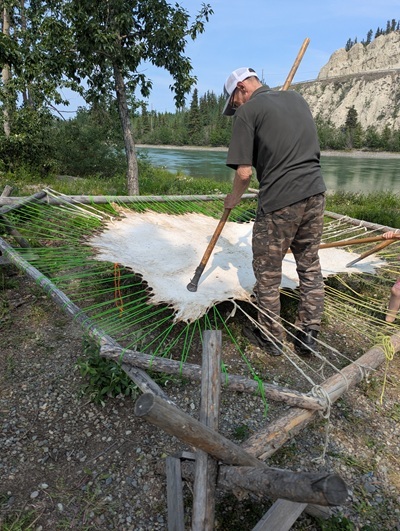
I thought of one fellow we watched scraping a hide, patiently working it with a wooden rod tipped with metal until it was soft enough to use in any number of possible projects. Hide preparation is long, difficult work. Even the tiny amount of work I tried out with the salmon skins required a great deal of delicacy. It's nothing compared to the piece we saw this gentleman at work on, which was probably moose or caribou hide and required stretching as well as endless scraping to remove hair and other impurities before fashioning it into something else: a drum, a jacket, a rattle...a song, warmth against the cold, a tool for healing.